Now Accepting Applications for the 2026-27 School Year!

Enroll Now!

Accountability & Policies

Paladin is dedicated to transparency and reports regularly to the Minnesota Department of Education (MDE), our Authorizer, Innovative Quality Schools (IQS), and the Paladin School Board. In addition, we strive to keep our families and surrounding community informed about how we are meeting students needs and the efforts we undertake to maintain continuous improvement. Click on any header below to learn more about our accountability measures and district policies.

Other policies, handbooks, and manuals will be made available per request under the Minnesota government data practices act under Minnesota statutes chapter 13.

Upon the request of an individual, Paladin Career & Technical High School must make available in a timely fashion financial statements showing all operations and transactions affecting income, surplus, and deficit during Paladin’s last annual accounting period.

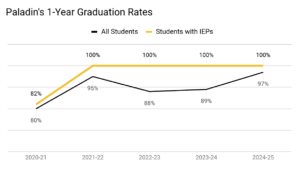
1-Year Graduation Rate Explained

In an effort to more meaningfully measure student success at Paladin, we have implemented a research-based graduation metric that takes into account the realities of high student mobility and credit deficiency while still challenging students to complete their high school credits in a timely manner. This 1-year graduation rate calculation differs from the traditional 4-, 5-, 6- and 7-year graduation rates calculated by MDE in that it disregards a student’s assigned graduation year and instead is calculated based on their rate of credit completion in their final year of high school.
Our 1-year graduation rate underscores the effectiveness of our school’s innovative practices. Through student-centered, strength-based education, and by incorporating student support, community-building, and restorative practices, we’ve empowered students to overcome their barriers, develop resilience, and reach their goal of graduation. Our 1-year grad rate has revealed our success in ways that the 4-year rate never could.

An Idea to Implementation

The 1-year graduation rate, based on similar examples in California and Chicago schools, measures the percentage of graduation-eligible students who actually graduate by the end of a year. In a given year, any student who should graduate based on their remaining credit totals would be considered eligible to graduate in this calculation, regardless of their grade or prescribed graduation year. This holds schools responsible for graduating all students regardless of their academic trajectories. In collaboration with our authorizer, Innovative Quality Schools (IQS), we developed a research-based 1-year graduation rate we feel could be replicated by other schools.

Addressing the Problem

4-year graduation rates have a limited ability to tell the stories of Charter schools serving at-risk students. Paladin’s 1-year grad rate more accurately presents our school’s outcomes by taking into account the realities of high student mobility, credit deficiencies, and other at-risk factors that lead to disruptions to high school education. This accountability practice helps tell a more complete story and decouples those students’ historic academic experiences from their accomplishments while enrolled at Paladin. It is for these reasons that a 1-year grad rate provides a more consistent and meaningful measure of our school’s impact on student success.

 Paladin’s 1-Year Graduation Rate Explained

Each year, Paladin Career & Technical High School evaluates the effectiveness of its programming and educational delivery methods, as well as the results from standardized testing and student support assistance. By aggregating the analytic data from each of these programs, Paladin can present a statistical snapshot of its students’ performance and growth.

As an independent charter school, Paladin Career & Technical High School has the ability to adapt to meet the needs of its students from year to year. Supported by data-driven practices, Paladin administrators, and teachers take efforts every year to shape the curriculum, support systems, and incentive programs available in order to best meet students’ needs. Each year, a site improvement plan is developed in conjunction with Paladin’s authorizer, IQS, and approval from the charter board.

These reports are part of the authorizer’s oversight of Paladin as a public charter school and help provide transparency regarding school performance, progress, and accountability. If you need this information in another language, please contact the school office, and we will provide support consistent with Paladin’s language access plan.

Under the Every Student Succeeds Act (ESSA), Paladin Career & Technical High School has been identified for Comprehensive Support and Improvement (CSI) by the Minnesota Department of Education based on state accountability data.

In partnership with families, staff, students, and community members, we have developed a School Improvement Plan that outlines our goals and strategies in reading, math, attendance, and student engagement.

Paladin Career & Technical High School operates a Title I, Part A Schoolwide Program (SWP) to address and reform our educational practices and ensure all students have equitable support and opportunities for academic success. By prioritizing educational resources for students with additional needs—particularly those performing below grade level, experiencing homelessness or poverty, or otherwise at risk—Paladin strives to provide the highest quality learning environment for all young people.

If you would like a paper copy of any document or a translation into another language, please contact the Paladin front office at 763-786-4799 or info@pcths.org.

In order to create the world’s best workforce, each year the Paladin Career & Technical High School board holds a public meeting, adopting a comprehensive, long-term strategic plan to support and improve teaching and learning that is aligned with that goal. An annual report on the previous year’s goals, outcomes and strategies can be found below.

The goal of the Minnesota READ Act is to have every Minnesota child reading at or above grade level every year, beginning in kindergarten, and to support multilingual learners and students receiving special education services in achieving their individualized reading goals Minn. Stat. 120B.12 (2023). In compliance with the READ Act, Paladin has developed and submitted the following Local Literacy Plan:

Paladin’s English Learner (EL) program provides instruction using various instructional models and appropriate materials. It integrates language and content to support students’ achievement of English language proficiency and meet state academic standards. All EL instruction will be aligned to grade-level standards, and all grade-level instruction will include supports that allow access and promote language acquisition. The following plan outlines the practices in place to identify and serve students who qualify for EL services.


Complaints – Students, Employees, Parents, Other Persons

Purpose

The school district takes seriously all concerns or complaints by students, employees, parents or other persons. If a specific complaint procedure is provided within any other policy of the school district, the specific procedure will be followed in reference to such a  complaint. If a specific complaint procedure is not provided, the purpose of this policy is to provide a procedure for general use.

General Statement of Policy

Students, parents, employees or other persons, may report concerns or complaints to the school district. While written reports are encouraged, a complaint may be made orally. Any employee receiving a complaint will advise the director or immediate supervisor of the receipt of the complaint. The Director will make an initial determination of the appropriate action to address the complaint. A person may file a complaint at any level of the school district; i.e., director, administrator, or school board. However, persons are encouraged to file a complaint at the building level when appropriate. If the complaint involves the director, the complaint must be filed with the Human Resource Officer or School Board Chair.

Depending upon the nature and gravity of the complaint, the director or other administrator receiving the complaint will determine the nature and scope of the investigation or follow-up procedures. If the complaint involves serious allegations, the matter will promptly be referred to the director who will determine whether an internal or external investigation should be conducted. In either case, the director will determine the nature and scope of the investigation and designate the person responsible for the investigation or follow-up relating to the complaint. The designated investigator will ascertain details concerning the complaint and respond promptly to the appropriate administrator concerning the status or outcome of the matter.

The appropriate administrator will respond in writing to the complaining party concerning the outcome of the investigation or follow-up, including any appropriate action or corrective measure that was taken, to the extent permitted by law. The director will be copied on the correspondence and consulted in advance of the written response when appropriate.

The response to the complaining party will be consistent with the rights of others pursuant to the applicable provisions of:

Minn. Stat. Ch. 13 (Minnesota Government Data Practices Act) or other law. 104-2
Legal Reference:
Minn. Stat. Ch. 13 (Minnesota Government Data Practices Act)